

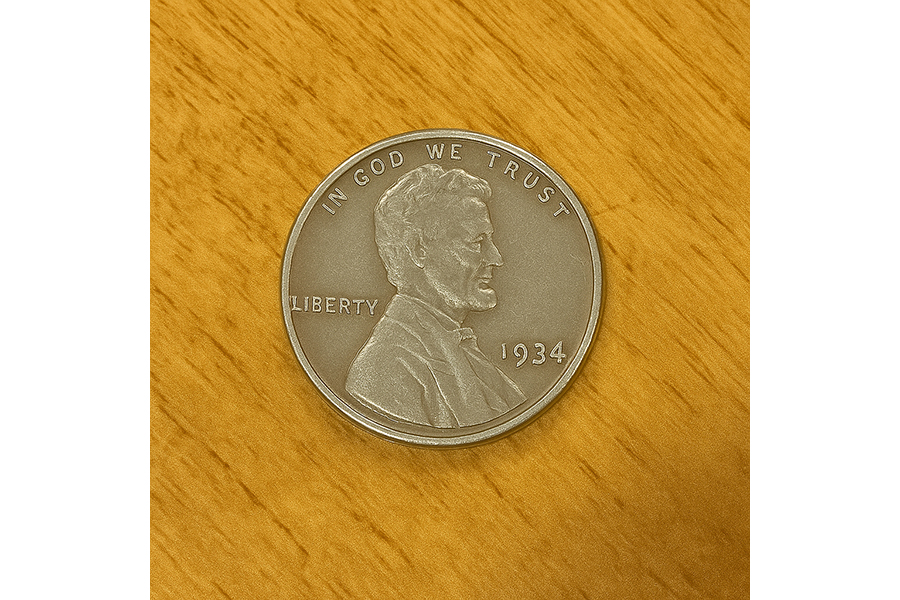
Columnist John Moore has collected pennies all of his life. Including this 1934 Lincoln wheat penny. He’ll miss the penny when it’s gone. Courtesy John Moore
There’s a scene in The Grapes of Wrath when two children ask for candy in a store and it costs more than the grandfather has. The candy canes were a nickel apiece, but the clerk sells them two-for-a-penny. The penny was a symbol of kindness. During the life of our country, pennies have symbolized a lot of things.
The U.S. Mint is ceasing production of the penny. It now costs more than one cent to make it. The coins are mostly zinc with a thin coat of copper, and most end up lost in drawers, tossed in jars, or left behind at cash registers. Economists argue that rounding prices to the nearest nickel will save time and money. Others say it is long overdue.
Canada stopped minting pennies in 2012. Still, for most of us, losing the penny feels like losing a small piece of who we are.
My sister and I saved our pennies. We’d take them to the Ben Franklin in Ashdown, Arkansas, which was owned by Mr. Evans. He made sure that a handful of pennies could buy a little kid a lot. There were jawbreakers, bubble gum, or a handful of marbles. A penny was small, but still worth something.
The penny’s story began long before Ben Franklin stores, but during the time of Ben himself. The first U.S. one-cent coin was minted in 1793, made of pure copper and nearly the size of today’s half-dollar. It featured a chain on one side and Lady Liberty on the other.
Over time, the penny’s look changed from the Flying Eagle of the 1850s, to the Indian Head of 1859, and then to the Lincoln cent in 1909, honoring Abraham Lincoln’s 100th birthday. The Lincoln penny became one of the most recognized coins in the world.
Since 1909, more than 300 billion pennies have been minted. Pennies have been tossed into fountains, pressed flat at roadside attractions, or slipped into the hand of a grandchild. For generations, they were the start of coin collections, or the clink in a Sunday offering plate.
The old saying, “A penny saved is a penny earned,” taught thrift and patience. “A penny for your thoughts” was an invitation to speak your mind. “Take a penny, leave a penny” trays still sit by registers in small-town stores. Pennies taught children to count, helped churches fund missions, and filled jars for school drives.
My friends and I played penny poker on rainy afternoons. Each of us brought a handful of copper coins. We used pennies for tiddlywinks, flipped them toward cups, and saw whose would spin the longest on the kitchen counter. Those afternoons were not about winning. They were about friendship and the feeling that even a penny could buy a little joy.
Pennies were lucky too. Finding one heads-up on the sidewalk meant good fortune. People still say, “Find a penny, pick it up, and all day you’ll have good luck.” Tossing one into a wishing well could make dreams come true. Lovers flattened them on train tracks and kept them as keepsakes. Soldiers carried them as charms from home.
In their small way, pennies became part of our superstitions, our traditions, and our hopes.
The penny has always stood for the idea that little things matter. It reminded us that kindness could be simple, that saving a little could grow into something big. The saying, “In for a penny, in for a pound,” speaks of commitment, and it fits the penny perfectly.
Mr. Evans at the Ben Franklin understood that. He sold things for a penny that made children smile. The same could be said of the store clerk in The Grapes of Wrath. When she sold those candies two-for-a-penny, she was preserving dignity for a family just trying to survive the Great Depression.
It’s easy to argue about efficiency and economics, but how do you explain that to a child proudly clutching three shiny pennies? Or to an old man fishing one from his pocket to hand to his grandchild? The loss of the penny is not just financial. It is emotional. It marks the end of an era when the smallest things still carried weight.
For more than 230 years, the penny has been a quiet witness to our nation’s growth. From the rough copper coins of 1793 to the gleaming zinc of today, each one has a story. When the last penny is struck, we will still say “penny for your thoughts,” even if there are no more to give.
And for kids who once traded their hard-earned pennies for a bit of candy and a smile, that memory will never lose its shine.
By John Moore, author, Puns for Groan People and Write of Passage: A Southerner’s View of Then and Now Vol. 1 and 2, are available on his website TheCountryWriter.com, where you can also send him a message.
For more stories about the Farmersville community see the next print, or digital edition of The Farmersville Times. Subscribe today and support local journalism.








0 Comments