

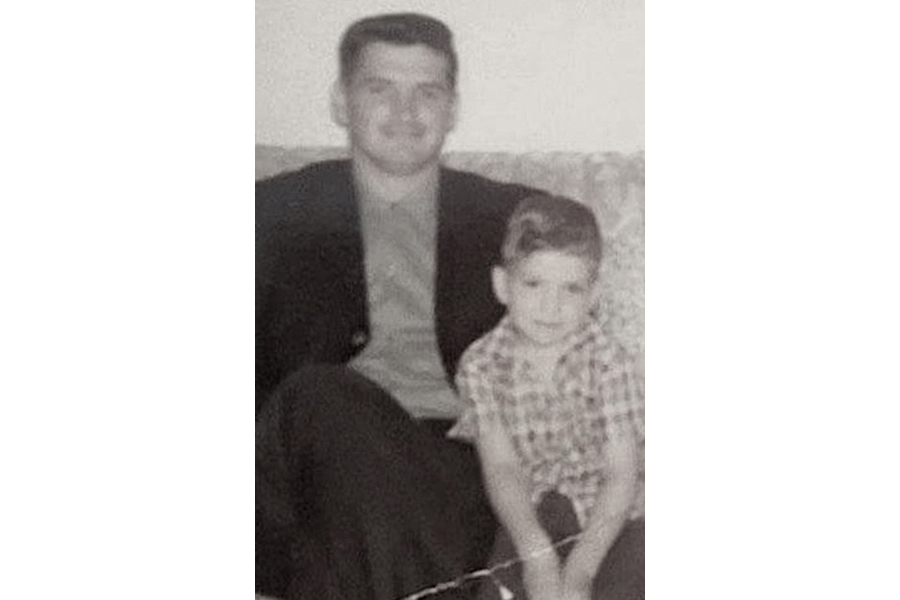
Columnist John Moore learned to ride a bicycle from his dad. The two are pictured here in a photo from 1968. Courtesy Sarah Ward
Bell-bottom jeans and bicycle chains are not friends. I share this bit of 1960s essential information for those who are participating in the return of bell-bottoms.
There are some nostalgic returns I support, but I’m on the banana seat fence when it comes to bell-bottoms. Sitting astride a banana seat atop a purple Murray bicycle, I rode through my Ashdown, Arkansas, childhood trying my best to keep my jeans out of the bicycle chain.
The holes and grease in and on my Sears britches were evidence of my failure.
Keeping growing children in clean clothes that fit was an impossibility. But my mom tried. Boy, did she try. My sister rode her bike less than I did, so she had fewer encounters with the bicycle chain, and consequently, mom. But mine were frequent.
Many years after its 1969 debut, I watched Easy Rider. The similarities between my neighborhood and the guys in the film who were riding two wheels while looking for acceptance were obvious to me.
Of course, there were many habits and communes in the movie that thankfully were absent on Beech Street, but the premise was the same.
Most kids first found freedom on the open road.
My dad taught me to ride a bike. We had a sidewalk in front of our house. I call it a sidewalk, which is usually defined as a stretch of concrete near the street.
Ashdown didn’t have much of that, but whoever built our red brick house had put three large blocks of cement from the steps of the front door to the gravel driveway where our 1960 Buick resided. And it was on those three blocks where my sister and I began our bicycling careers.
Dad would hold on to the back of the bike seat and propel us across the blocks and into the yard. It was up to us to propel ourselves across the soft sod, with enough pedaling and steering to continue.
We learned to ride on an old family bike. Once we mastered not falling over, mom and dad decided we were ready for our own bicycles. The next Christmas, when I was eight and my sister was six; Santa left two Murray bicycles in front of the tree.
Both bikes were purple, but there were distinctions. My sister’s had a girl’s bike with no center bar, but it also had a basket on the handlebars. The basket featured plastic white flowers with purple centers. I suspect there was a lady in the design department at the Murray Bicycle Company.
As we grew older, we were trusted to ride further. My mom would allow us to search for pop bottles and then take them to Shur-Way Grocery to cash them in. My sister and I would dig through the ditches, toss the bottles into her basket, then take them home to wash before getting a nickel for each one.
Later, we were allowed to ride to our grandparents’ houses for visits. Go see a friend. To a ball game on a corner lot. School events.
And everywhere we went, we just left our bikes outside on their kickstands or leaning against a pole or building. We never worried about someone taking them. Every kid in town knew which bike belonged to what kid. Possession of another kid’s bike was an admission of guilt.
When I saw my first 10-speed bike, I had to have one. But they were expensive. And my dad, having come from poor Arkansas stock, taught me financial responsibility early. The purple Murray was on him. A high-dollar 10-speed was on me.
It took mowing a lot of $2 yards to save enough to buy a 10-speed. Fifty yards, to be exact. And to mow those yards, I had to drag a mower behind my bike, with a gallon gas can in one hand and one of the bicycle handlebars in the other.
A stop at the 7-11 for a quarter’s worth of gas, and then drag everything across town to your destination. That’s where I got the 10-speed money.
That bike took me to a new level of cycling. The people who rode those weren’t going to ball games or grandmas. They were cyclists. Riding 10, 20, 30 miles wasn’t uncommon.
With friends like Steve and Jim, I learned about the history of Little River County. A historic area of southwest Arkansas where I was born, which will always be home.
I saw abandoned roads and places. Met people who were at the end of their lives and wanted to share what they’d lived. Rode in the rain, heat, and cold.
Like Peter Fonda and Dennis Hopper in Easy Rider, it felt free.
Today, I see very few kids riding bikes. For that matter, I see very few kids outside at all. Video games and the Internet keep their heads down and their minds in an artificial world.
The real world is still out there. And there’s no better way to see it than on a bike.
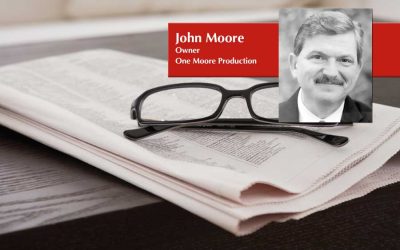
By John Moore, author, Puns for Groan People and Write of Passage: A Southerner’s View of Then and Now Vol. 1 and 2, are available on his website TheCountryWriter.com, where you can also send him a message.
For more stories about the Farmersville community, see the next print or digital edition of The Farmersville Times. Subscribe today and support local journalism.






0 Comments