

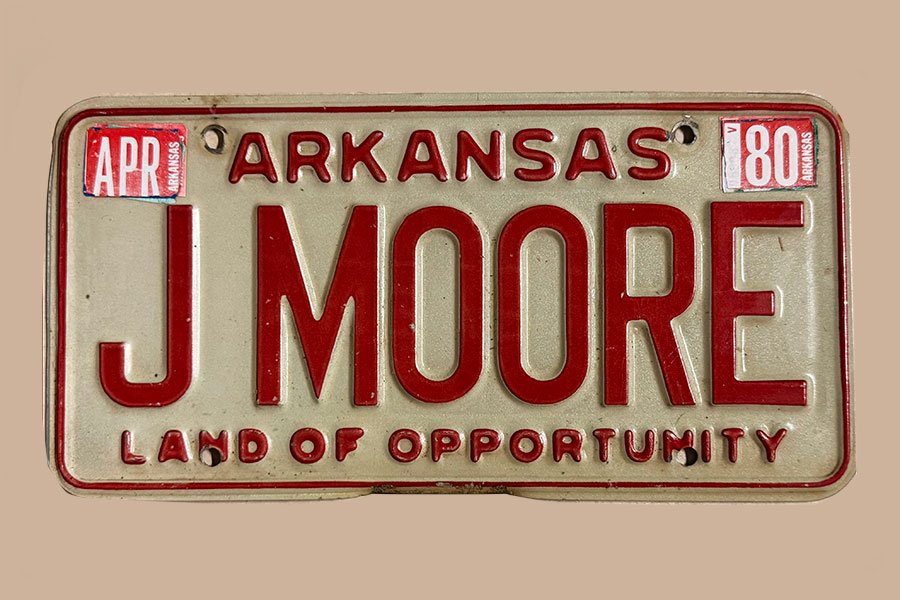
Columnist John Moore still has the license plate from his first car. A 1966 Ford Mustang. Photo: John Moore
Lee Iacocca gave us two American classics: the Ford Mustang and the Chrysler minivan. The first was intended to compete with the Chevy Corvair Monza. The latter was designed to take the place of vans and station wagons that were becoming less practical for many families.
Most people today probably could not identify a Corvair Monza if they were riding in it. The last one rolled off the assembly line in 1969 and it quickly faded into automotive history.
Full size vans are still around. But the once ubiquitous station wagon was largely laid to rest after the success of Iacocca’s minivan. It was a vehicle that was first developed when he was at Ford Motor Company. Ford leadership never moved forward with it. That decision would later prove costly.
You would think the man who had the idea for the Mustang and took it from concept to rolling off the assembly line in just 18 months would be considered invaluable. But not to Henry Ford II.
In 1978, Ford summoned Iacocca to his office for a short meeting. The reason for the firing was summed up in one simple sentence that has since become famous.
“Sometimes, you just don’t like somebody.”
Two years later, Chrysler Corporation was on the verge of collapse. The company had been poorly managed and was hemorrhaging money. Iacocca was brought in during 1980 to save it.
Few people believed he could.
But Iacocca had an idea that Ford had rejected. He revived the small front wheel drive family van concept he had championed at Ford earlier in the decade.
The result was the Chrysler minivan.
In 1976, America was celebrating its bicentennial. That same year I was celebrating something that felt just as historic to a teenager.
My first car. It was a 1966 white Ford Mustang.
We were living in a house my parents had just built on Locust Street in Ashdown, Arkansas. It was on a busy cut through between the main highway in town and the road that led to Millwood Lake, one of the state’s great fishing spots.
That meant my buddies could always see if I was home. If the Mustang was parked out front, someone usually stopped.
And off we would go.
My Mustang had a six-cylinder engine and a three-speed transmission. It was not a racecar, but it ran well and got better gas mileage than most of the vehicles my friends were driving.
The country was still feeling the effects of the oil crisis of the early 1970s and gasoline prices had become a real concern. A car that stretched a gallon of gas a little farther was a big advantage for a teenager.
It is hard to believe now, but you once could buy a Mustang for just a few hundred dollars. My dad paid $500 for mine.
You couldn’t buy the hubcaps for that now.
Ford made millions of Mustangs and the car quickly became one of the most recognizable vehicles in American history. Even today it remains one of the longest running and best selling sports coupes ever produced.
But Iacocca’s second big automotive idea would end up transforming family transportation even more.
Launched in 1984, the Dodge Caravan and Plymouth Voyager were two of the most influential vehicles ever built.
They were smaller than full size vans, fit easily into a normal garage, seated six or seven passengers, and delivered far better fuel economy than the large vans and station wagons many families had been driving.
Moms loved them and Chrysler sold millions. I was one of those early customers.
Having had great luck with the Mustang, I trusted Iacocca again and bought one of his minivans.
It quickly became the family workhorse.
We drove it everywhere. Vacations, ballgames, fishing trips, church events, and family visits. It was efficient, dependable, and about as practical as a vehicle could be.
Chrysler summaries and automotive industry data show that more than 15 million Chrysler minivans have been sold since their debut.
That is about five million more than Ford has sold Mustangs.
Henry Ford II was once asked years later if firing Iacocca had been a mistake. His answer was short and honest.
“Probably.”
The man was known for being economical with words.
Ford died at age 70 in 1987, nine years after firing Iacocca.
Lee Iacocca lived a long life and passed away in 2019 at age 94.
In a way, Iacocca had the last word.
He outlived Henry Ford II. And he outsold him.
More importantly, he helped create two vehicles that became woven into the everyday lives of millions of Americans.
For my family, those vehicles carried us through some of our best memories.
Road trips in the Mustang. Family vacations in the minivan.
Miles of highways, back roads, laughter, and stories that still get told.
And we have a guy named Iacocca to thank for those miles.
Enjoying this column? Let us know. Support your local community newspaper, subscribe to The Farmersville Times.
By John Moore | TheCountryWriter.com








0 Comments